A cotton-wear label with a festival calendar
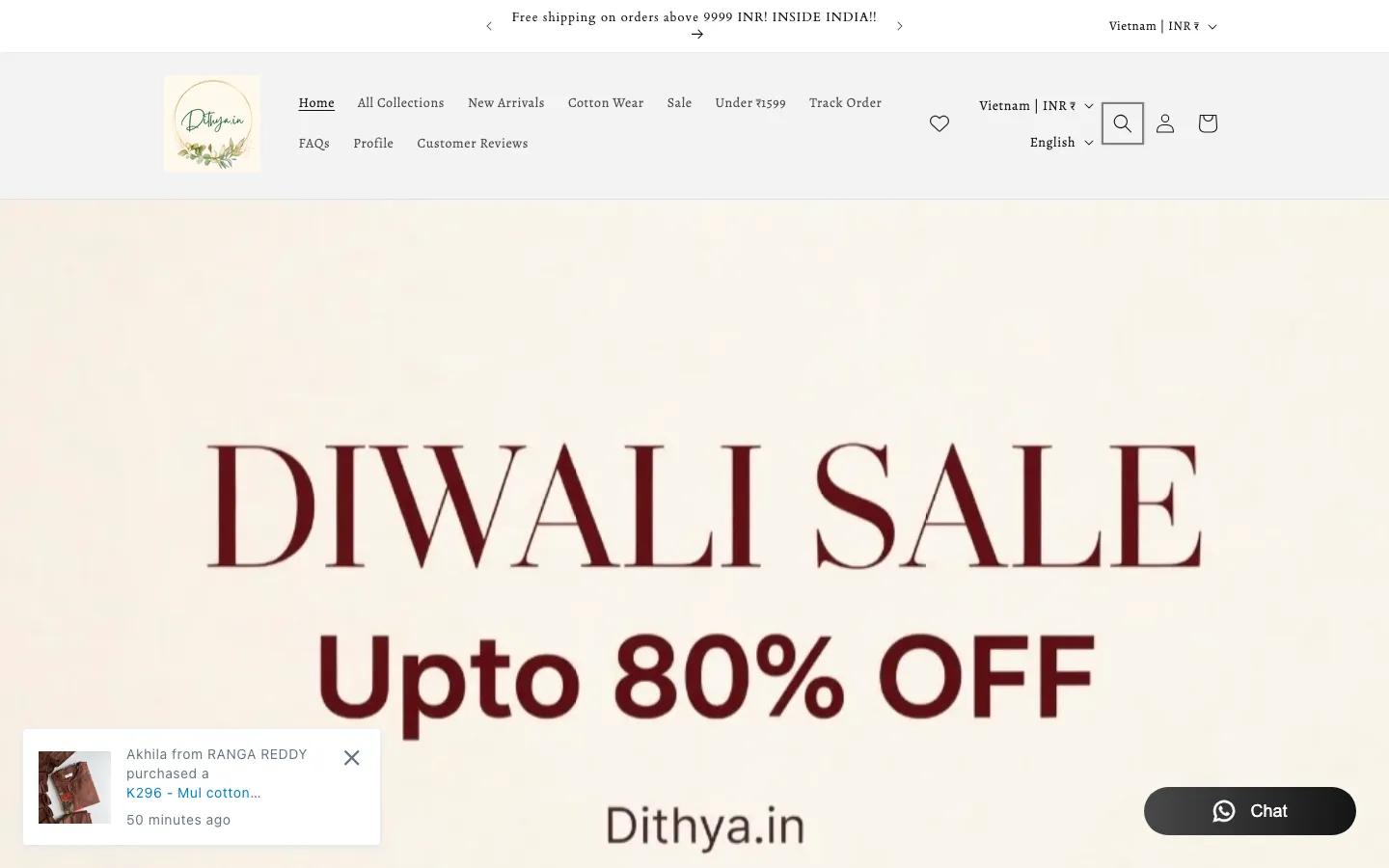
Dithya sells cotton kurta sets, block print kurtas, palazzo pants and dupattas from a Shopify store that runs in English and rupees. The menu shows how people shop there. There is a Cotton Wear collection, a Sale page and an "Under ₹1599" edit, and on the day we looked a Diwali sale banner covered the homepage.
A sale like that pushes a lot of orders through checkout in a short window. Each needs a tax invoice.
What an Indian tax invoice has to carry
A GST-registered seller identifies itself with a GSTIN, numbers its invoices in a running series of up to 16 characters, dates them, and lists every item with an HSN code, a taxable value and the tax charged. The tax split follows the delivery state. Ship inside the seller's own state and the tax appears as CGST plus SGST. Ship across a state line and it turns into one IGST line.
Two smaller rules catch new sellers out. The invoice series has to stay unique within a financial year, which in India runs from 1 April to 31 March, so many stores restart their numbering each April. And the number of digits expected in an HSN code depends on annual turnover, with larger sellers giving more of them.
Clothing adds a wrinkle of its own. The GST rate on a garment depends on its sale price per piece, so one cart that holds a ₹449 dupatta and a ₹3,000 kurta set can carry two different rates. Woven garments sit in chapter 62 of the HSN schedule, scarves and dupattas in 6214, and the invoice has to show the right code line by line.
How Dithya runs it
Dithya installed PDF Invoice in 2025. Invoices come out in English with amounts in INR. Tax fields are switched on, so the GSTIN and the tax lines print on the document, and each product line can carry its SKU and HSN code. The app emails the invoice to the customer automatically.
The account holds six document types: invoice, refund, packing slip, pro forma, quote and credit note, spread across several template families. The sample on this page uses the Elegent layout, the template family the account's main documents come from. It puts the shop name top left, the title top right, a plain items table in the middle and the addresses at the foot.
The title reads Tax Invoice and the date prints as DD/MM/YYYY, the way Indian customers write it. Everything on that sample except the brand name is invented. The order has a kurta set, two block print kurtas, palazzo pants and a dupatta. All four lines carry 5% GST, shown as 2.5% CGST and 2.5% SGST on each line and again in the total, which comes to ₹4,037.25 on a ₹3,845.00 subtotal. A flat rate keeps the arithmetic readable here, and a real catalogue would set the rate per product.
A customer who orders in Jaipur and has it sent to a cousin in Pune produces a different tax split from one who ships to their own address. The delivery state always wins, so the invoice has to be generated from the order and not from a fixed template of lines.
Results
The app has sent more than 5,700 documents since 2025. That is the one number we can share. The app generates each invoice from the order and emails it to the customer.
Try it for your store
If you sell in India, PDF Invoice on the Shopify App Store is a quick place to start. Add your GSTIN once in the settings, turn on the HSN field, and pick the template that suits your orders.